Hire a CCSL service or generate one in-house?
A combined continuity and spotting list has to match a particular cut. Choosing who prepares it starts with the handoff: who can see the master, who knows the proper nouns and who owns questions after the distributor reads it?
- Picture · a torn schedule on the station wall
- Dialogue · MIRA (off screen): “The last train left.”
- Review · confirm the character name against the approved list
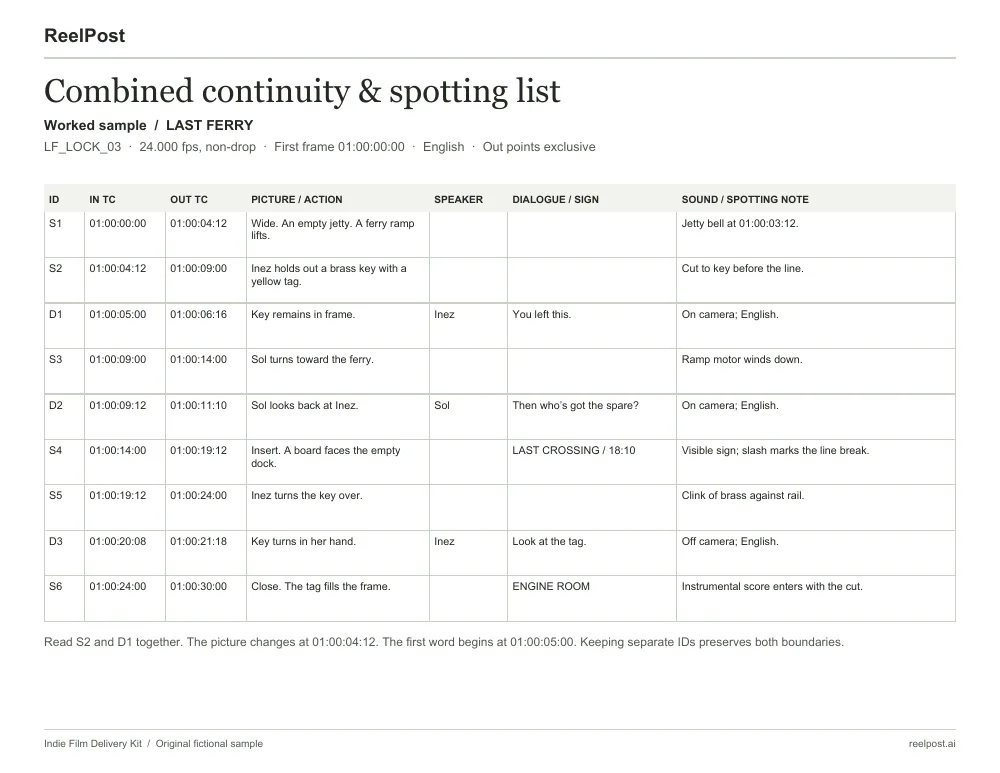
Measure the review work that follows transcription
Give each operator a brief containing the same character list, terminology and timecode conventions. Leave one deliberately unresolved but genuine production question in the sample. A background announcement might identify the station in two languages, for example. Track who recognizes the uncertainty, how the question reaches the production contact and where the approved answer is recorded. A fast first draft matters only when the next reader can trust the reviewed document.
Run the revision test with a small but specific edit. Remove the head of a shot, move a dialogue overlap and replace an insert containing text. Check the rows before and after each change, including timecodes downstream. Request a clear revision policy from a service and estimate the staff time required to repeat the same checks internally. Compare the two completed handoffs, including unresolved questions and what each route will cost when the distributor requests another revision.
Who resolves the details only your production knows?
Give both workflows the same short scene and written delivery requirements. Include an off-screen voice, a sign that matters to the story and two characters talking over each other. Check picture description, speaker identity and the timecode convention against the master. Count corrections and the time a knowledgeable person spent resolving them. Repeat with a revised cut.
Choose for the handoff
Ask a service for a quote against your actual running time, language tracks, turnaround and revision policy. For an in-house workflow, include operator review and correction time. A software-generated first draft can save transcription work, while your team still owns names, ambiguity and the decision to hand the document over.
Run a short production trial
Use a scene you have permission to share. Record its file name, running time, frame rate and revision date. Give each operator the same brief and the same acceptance criteria. Include somebody who receives the finished deliverable in the test. They may need a different export, document layout or way to mark approval than the person who prepares it.
Log setup time separately from review and rework. If one test uses a familiar operator and another starts with a new user, record that difference. Put open questions in the trial notes and ask each vendor to demonstrate the answer on your sample before committing a production.
Make the purchasing decision repeatable
Before the trial, write down three conditions the final workflow has to satisfy. Choose observable outcomes such as reproducing a reviewer’s note on the correct shot, exporting an approved artifact that opens in the receiving system, or recovering a prior revision after a mistaken edit. Name the person who can accept each result. Keep helpful extras in a separate column so a polished demonstration cannot obscure a missing production requirement.
Use the first run to learn the interface and the second to measure the workflow. Make the second change comparable in size to a normal late-stage revision. Count minutes spent preparing input, waiting for processing, checking the output, correcting mistakes and communicating the decision. Label any waiting time that occurred while an operator could do other work. The useful comparison is the cost and timing of your team’s complete handoff.
Record the date, product configuration, plan and any support assistance used for the trial. Confirm current pricing, project limits, retention and export requirements directly with each provider. Write a short decision note covering the tested version, the successful outputs, any unresolved questions and the owner of the next trial. Revisit that note when the next show changes language, volume, review audience or delivery format.
Questions about this resource
Which instructions apply to my particular delivery?
Confirm the destination, title version and deliverable with the receiving team. Use the linked references and worked example to prepare questions before you send a final file.
Can my team see this workflow on a demo?
Join the ReelPost waitlist with your email and reply to the welcome message. A team member can arrange a walkthrough around the deliverable on your schedule.