Dialogue list template for film delivery
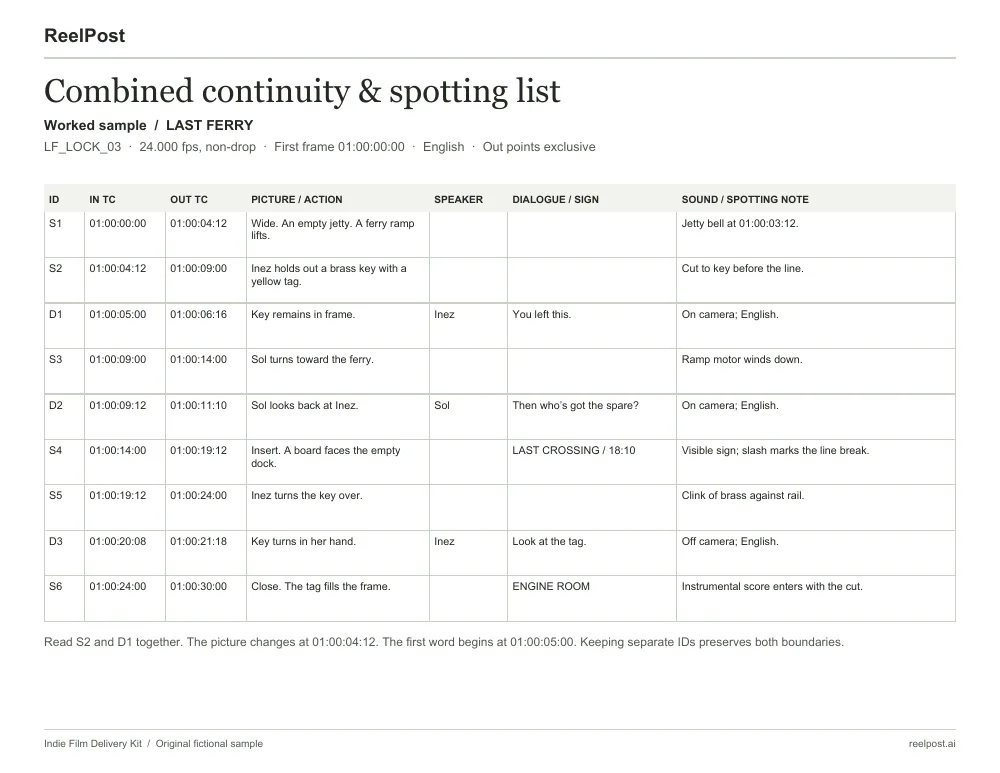
When a distributor asks for a dialogue list, the sound team needs a reliable account of who said what in the released cut. The workbook gives each spoken turn an ID, a time range, a speaker, an on-camera or off-camera label, exact words and a review note. The three filled entries come from the same fictional dock scene as our CCSL sample.
- D3 · 01:00:20:08–01:00:21:18 · Inez, off camera.
- Dialogue · “Look at the tag.”
- Review note · Voice matches Inez in the preceding shot.
Start from the released mix
Load the locked picture and the corresponding mix together. Check a visible mouth movement near the head, then another near the tail. A temporary dub or a revised picture can move a line even when both filenames contain the word final. Write the relevant picture ID, language and start timecode into the workbook before transcribing.
Review the screenplay for names and spellings, then listen to what reached the mix. An actor may use a contraction, interrupt another speaker or change a number. In Last Ferry, Sol says “Then who’s got the spare?” Keeping that exact phrasing gives the dubbing team a meaningful cue for the reply. Put doubts in the review column with their location.
Choose a repeatable boundary
Make the in mark at the beginning of the spoken turn and the out mark according to the convention agreed with the receiver. The example uses the first frame outside the line. A cue at 01:00:05:00 through 01:00:06:16 spans one second and sixteen frames at 24 fps. Keep the frame field intact when a spreadsheet would otherwise convert the value into a clock time.
A long breath within a sentence and a pause between speakers create different editing decisions. Read the next line before splitting the first. If two voices overlap, assign them independent rows with intersecting time ranges so future readers can see the overlap. A single row that silently merges both voices can obscure a response during localization.
Describe the speaker precisely
Use the approved character list and the identifiers the audience knows at that point in the story. A scene can begin with an unidentified radio voice and reveal its speaker later. Keep an internal identification note separate from any public-facing label. The localization editor can then make a decision that respects the reveal.
For the final line in our sample, the picture stays on the key while Inez says “Look at the tag.” The speaker field still reads Inez, and the position field says off camera. A door slam at that point belongs in a sound note if the brief includes one. It should not appear as a line delivered by the character.
Hand the transcript to a second listener
Ask a reviewer to check a quiet line, a name, a number and a line spoken outside the frame. Have them flag uncertainties against the cue ID. Once someone resolves a line, record the evidence briefly and keep the approved text in the dialogue column. Strip internal review chatter from the external copy according to the client’s requirements.
Listen to the full export once without the screenplay. Check for speech under logos, through transitions and after the final credits. Confirm that the delivery language and reel start appear in each separated file. If the recipient also needs subtitle timing, create a separate spotting pass with reading speed, line breaks and shot changes considered for that use.
For a final listening exercise, cover the speaker column and play the three sample cues in sequence. Ask a reviewer to identify each turn from the audio and picture position alone. Record where they needed the preceding shot for context. Those spots are worth a precise speaker note, especially before the list is split among several translators.
Questions about this resource
Can I adapt the template to my delivery schedule?
Yes. Work from a copy, replace the sample material and match the column names, timecode conventions and file format to your recipient’s written brief.
Can my team see this workflow on a demo?
Join the ReelPost waitlist with your email and reply to the welcome message. A team member can arrange a walkthrough around the deliverable on your schedule.