Compare end credits workflows
Compare credits systems with a revision, not just a first render. A beautiful first pass tells you about typography. Correcting a name after sign-off tells you how your production will actually finish.
- Approved list · Ana Muñoz, sound editor
- Correction · add supervising before sound editor
- Check · column alignment, run time, approved version
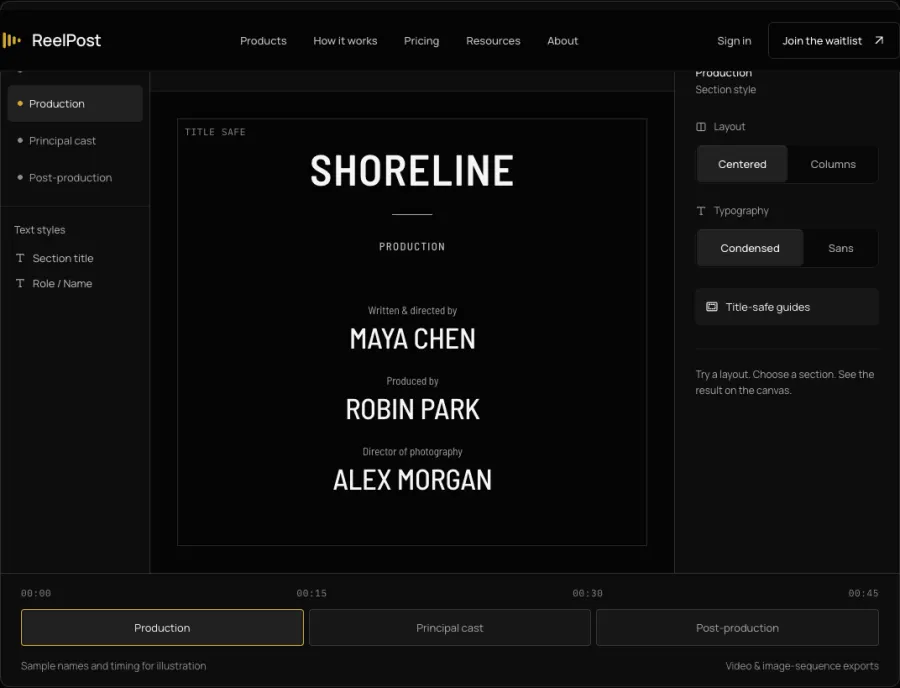
Trace a single name through approval and render
Choose a crew member credited in two departments. Change the role in one department and keep the other role exactly as approved. Ask two different people to review the same spelling correction. The exercise reveals who controls the authoritative list and how the team detects overlapping requests. Save the marked preview, the approved list and the subsequent render under separate revision names.
Place both versions in the finishing timeline and compare the first frame, the changed credit and the last frame. Look for a correction that changes line length, shifts a paired column or affects the duration available for a logo card. Ask the online editor to import the generated asset without help from the person who created it. Record every extra step needed to achieve the final frame size, frame rate, alpha handling and runtime.
What does a last-minute correction cost the production?
Build a small roll with two columns, a long production-company name, an accent in a surname and a logo card. Have someone who did not build it submit a correction. Track who accepts it, where the approved spelling lives, and whether the review copy and final export can be traced to the same list. Re-open the previous version before deciding the change is complete.
Choose for the handoff
Endcrawl describes unlimited renders, cards, custom fonts and support for getting a project started. Ask for the services and format your show actually needs. Test ReelPost when name review, a shared approval and the resulting render need to stay together. Compare the output on the finishing timeline at the delivery frame rate.
Run a short production trial
Use a scene you have permission to share. Record its file name, running time, frame rate and revision date. Give each operator the same brief and the same acceptance criteria. Include somebody who receives the finished deliverable in the test. They may need a different export, document layout or way to mark approval than the person who prepares it.
Log setup time separately from review and rework. If one test uses a familiar operator and another starts with a new user, record that difference. Put open questions in the trial notes and ask each vendor to demonstrate the answer on your sample before committing a production.
Make the purchasing decision repeatable
Before the trial, write down three conditions the final workflow has to satisfy. Choose observable outcomes such as reproducing a reviewer’s note on the correct shot, exporting an approved artifact that opens in the receiving system, or recovering a prior revision after a mistaken edit. Name the person who can accept each result. Keep helpful extras in a separate column so a polished demonstration cannot obscure a missing production requirement.
Use the first run to learn the interface and the second to measure the workflow. Make the second change comparable in size to a normal late-stage revision. Count minutes spent preparing input, waiting for processing, checking the output, correcting mistakes and communicating the decision. Label any waiting time that occurred while an operator could do other work. The useful comparison is the cost and timing of your team’s complete handoff.
Record the date, product configuration, plan and any support assistance used for the trial. Confirm current pricing, project limits, retention and export requirements directly with each provider. Write a short decision note covering the tested version, the successful outputs, any unresolved questions and the owner of the next trial. Revisit that note when the next show changes language, volume, review audience or delivery format.
Questions about this resource
Which instructions apply to my particular delivery?
Confirm the destination, title version and deliverable with the receiving team. Use the linked references and worked example to prepare questions before you send a final file.
Can my team see this workflow on a demo?
Join the ReelPost waitlist with your email and reply to the welcome message. A team member can arrange a walkthrough around the deliverable on your schedule.